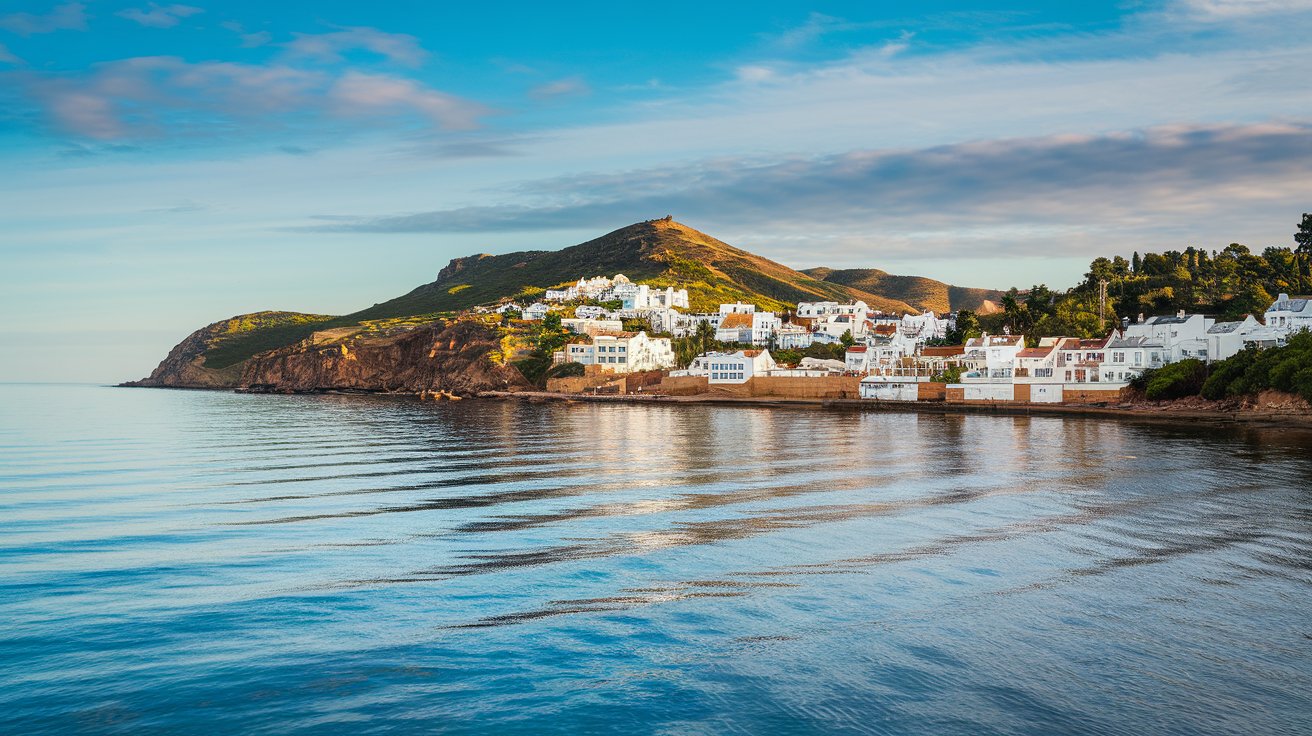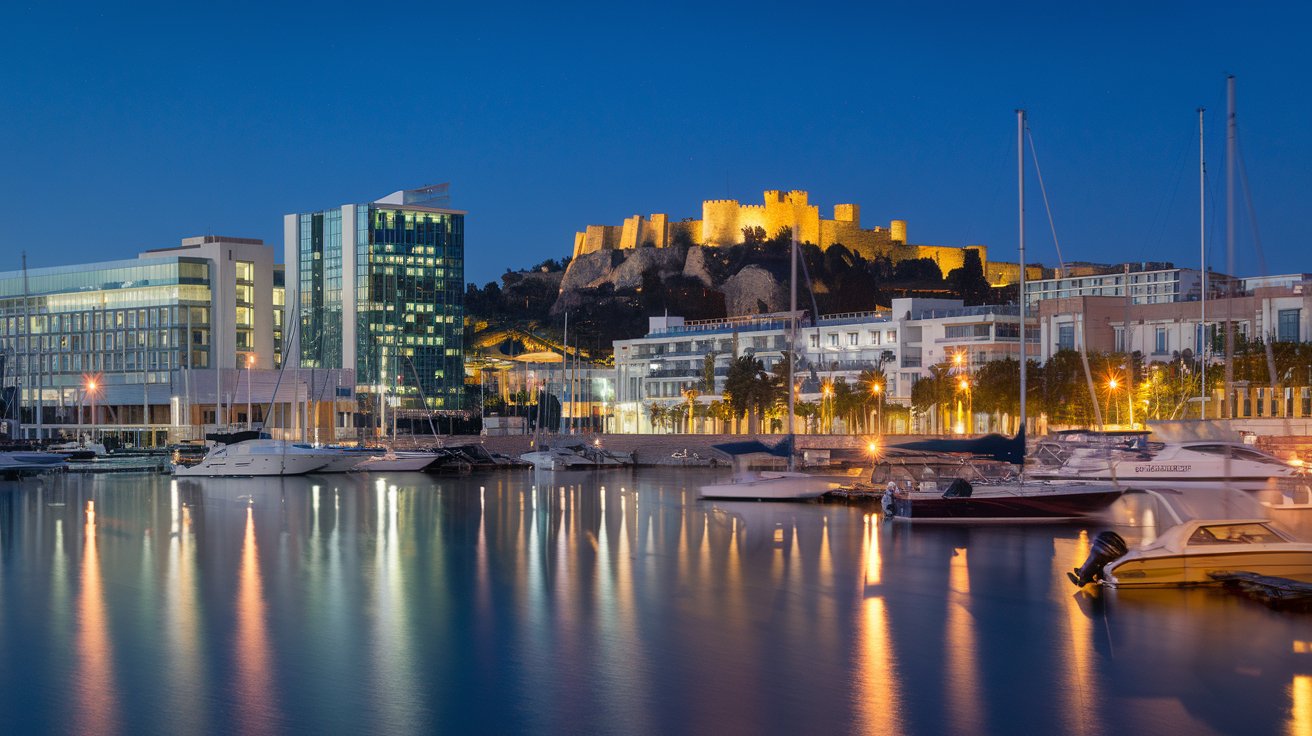
Benidorm is located on Spain’s eastern Mediterranean coast in the province of Alicante, within the autonomous community of Valencia. This world-famous resort city sits on the Costa Blanca, approximately 50 kilometers northeast of Alicante city and 140 kilometers south of Valencia city. As one of Spain’s most popular tourist destinations, Benidorm attracts over 4.5 million visitors annually with its stunning beaches, towering skyscrapers, and year-round Mediterranean climate.
Exact Geographic Location of Benidorm
Benidorm is situated at coordinates 38.5386° N latitude and 0.1312° W longitude on Spain’s southeastern Mediterranean coastline. The city occupies a privileged position between two prominent capes—Punta de Canfali to the north and Serra Gelada to the south—creating a natural amphitheater that protects its beaches. This geographic location in the province of Alicante places Benidorm within the Valencian Community, one of Spain’s 17 autonomous regions. The city covers approximately 38.5 square kilometers and sits at sea level, with the Sierra Cortina mountains rising dramatically behind it, reaching elevations of over 1,000 meters.
The strategic position of Benidorm has made it one of Europe’s most accessible beach destinations. Located on the Costa Blanca, which translates to “White Coast,” the city benefits from over 300 days of sunshine annually and average temperatures ranging from 57°F in winter to 86°F in summer. As of 2026, Benidorm’s permanent population stands at approximately 70,000 residents, but this number swells to over 400,000 during peak summer months, demonstrating its massive appeal as a tourist destination in Spain.
Which Costa is Benidorm On?
Benidorm is located on the Costa Blanca, Spain’s eastern Mediterranean coastline that stretches for over 200 kilometers through Alicante province. The Costa Blanca designation encompasses the entire coastal region from Dénia in the north to Pilar de la Horadada in the south, with Benidorm positioned centrally within this stretch. This coastal region earned its name from the brilliant white color of its beaches and the whitewashed villages dotting the landscape. The Costa Blanca region has become synonymous with beach tourism, attracting predominantly British, German, Dutch, and increasingly American visitors seeking sun, sea, and vibrant nightlife.
Unlike other famous Spanish costas such as Costa del Sol in Malaga (which is on the southern coast) or Costa Brava in Catalonia (on the northeastern coast), the Costa Blanca offers a unique combination of warm waters, fine sandy beaches, and modern infrastructure. Benidorm serves as the undisputed capital of Costa Blanca tourism, with its iconic skyline of high-rise hotels and apartments distinguishing it from other Mediterranean resort towns. In 2026, the Costa Blanca tourism sector generates over €3.2 billion annually, with Benidorm accounting for approximately 40% of that economic activity.
Is Benidorm in Alicante Province?
Yes, Benidorm is located within Alicante province, one of three provinces that comprise the Valencian Community autonomous region. Alicante province extends along Spain’s southeastern coast and inland areas, covering 5,817 square kilometers with over 1.9 million residents as of 2026. The province’s capital, Alicante city, sits approximately 50 kilometers southwest of Benidorm and serves as the administrative and economic center of the region. The province of Alicante includes 141 municipalities, with Benidorm ranking as one of the most economically significant due to its tourism industry.
The relationship between Benidorm and Alicante is fundamental for travelers to understand. While they are distinct cities, they share excellent transportation connections and complement each other perfectly for visitors. Alicante provides the main international airport and cultural attractions, while Benidorm offers concentrated beach resort facilities. The coastal highway AP-7 and the national road N-332 connect the two cities efficiently, with journey times of approximately 40 minutes by car. Many American tourists visiting Spain in 2026 choose to explore both destinations, spending time in historic Alicante before heading to Benidorm’s beaches and entertainment venues.
Nearest Airports to Benidorm
Alicante-Elche Airport (ALC) is the nearest major airport to Benidorm, located approximately 60 kilometers to the southwest. This international airport serves as the primary gateway for the Costa Blanca region, handling over 15.8 million passengers in 2025 and projected to exceed 16.5 million in 2026. The airport offers direct flights from numerous American cities during peak season, including New York, Miami, and Los Angeles, though most U.S. travelers connect through European hub airports like London, Amsterdam, or Madrid. Transfer time from Alicante Airport to Benidorm ranges from 45 to 60 minutes depending on traffic and transportation method.
Transportation options from Alicante-Elche Airport include direct bus services to Benidorm operated by ALSA, which depart every 30-60 minutes during peak season and cost approximately €10-12 one way. Private transfer services and car rentals are readily available at the airport, with rental costs starting around €25-35 per day in 2026. Taxi services to Benidorm typically cost €75-90 for the journey. Valencia Airport, located 145 kilometers to the north, serves as an alternative option with slightly longer transfer times of approximately 90-120 minutes. For American travelers planning their 2026 trip, booking airport transfers in advance during July and August is highly recommended due to high demand.
Does Benidorm Have Its Own Airport?
No, Benidorm does not have its own commercial airport. The city relies entirely on nearby Alicante-Elche Airport for air connectivity. While there have been occasional discussions about developing a local airstrip or expanding facilities at the disused military airfield near La Nucia (approximately 10 kilometers inland), no concrete plans exist as of 2026. The proximity of Alicante Airport, combined with excellent road infrastructure, has made a dedicated Benidorm airport economically unnecessary. The absence of a local airport actually benefits the region by concentrating resources and preventing environmental impact on Benidorm’s densely developed coastline.
Some travelers mistakenly search for “Benidorm Airport” when planning their trips, but all commercial flights arrive at Alicante-Elche Airport. This arrangement works efficiently for the region, as the airport serves multiple Costa Blanca destinations including Alicante city, Torrevieja, Calpe, and Altea. For American tourists accustomed to multiple airports serving major destination areas, it’s important to understand that European resort cities typically share regional airports. The well-developed ground transportation network ensures that reaching Benidorm from Alicante Airport is straightforward and affordable, with multiple daily connections throughout the year.
Is Benidorm on Mainland Spain?
Yes, Benidorm is located on mainland Spain, specifically on the Iberian Peninsula’s eastern Mediterranean coast. This distinguishes it from Spain’s island destinations like the Balearic Islands (Mallorca, Menorca, Ibiza) or the Canary Islands (Tenerife, Gran Canaria). Being on the mainland provides several advantages for travelers, including easier accessibility, more transportation options, and the ability to explore surrounding regions by car. Mainland Spain location means visitors can easily take day trips to Valencia city, explore inland mountain villages, or visit nearby attractions without requiring additional flights or ferry services.
The mainland position of Benidorm contributes significantly to its development as a year-round destination rather than a seasonal island resort. Located on continental Spain provides more stable weather patterns, better infrastructure connections, and lower transportation costs compared to island destinations. For American travelers planning Spanish vacations in 2026, understanding that Benidorm is on the mainland helps in trip planning, particularly for those wanting to combine beach time with cultural excursions to cities like Valencia, Alicante, or even Barcelona (approximately 450 kilometers north). The excellent highway system connects Benidorm to Spain’s major cities, making multi-destination itineraries practical and cost-effective.
Distance from Major Spanish Cities
Benidorm’s position relative to Spain’s major cities makes it an accessible destination from multiple entry points. The resort city sits 140 kilometers south of Valencia, Spain’s third-largest city, with driving time of approximately 90 minutes via the AP-7 toll highway. Madrid, the Spanish capital, lies 450 kilometers to the west, representing a 4-hour drive or a 5-hour high-speed AVE train journey to Alicante followed by local transportation. Barcelona, on the northeastern coast, is positioned 540 kilometers from Benidorm, requiring approximately 5.5 hours by car or a combination of high-speed rail and local transport.
For travelers exploring southern Spain, Benidorm is approximately 460 kilometers from Malaga on the Costa del Sol, a journey of about 4.5 hours driving along the coastal and inland highways. The city of Murcia lies 120 kilometers to the southwest, representing just over an hour’s drive. These distances make Benidorm an excellent base for exploring multiple regions of Spain, particularly for American tourists who rent vehicles and plan extended stays. In 2026, many visitors combine Costa Blanca beach time with cultural exploration of Valencia’s City of Arts and Sciences, Alicante’s historic Santa Barbara Castle, or day trips to the medieval town of Guadalest nestled in the nearby mountains just 25 kilometers inland.
Understanding Benidorm’s Regional Context
The Valencian Community autonomous region, where Benidorm is located, represents one of Spain’s most dynamic and economically important areas. This region comprises three provinces: Castellón to the north, Valencia in the center, and Alicante to the south where Benidorm sits. The Valencian Community has its own distinct identity, with Valencian (a dialect of Catalan) recognized as an official language alongside Spanish, though Spanish dominates in Benidorm’s tourism areas. Understanding this regional context helps visitors appreciate the cultural nuances they’ll encounter, from local festivals like Las Fallas to regional cuisine featuring paella, horchata, and fresh Mediterranean seafood.
Benidorm’s location within this framework provides unique advantages. The city benefits from Valencian Community policies promoting tourism development, environmental protection, and infrastructure investment. As of 2026, the regional government has invested over €180 million in Costa Blanca tourism infrastructure, including beach improvements, public transportation enhancements, and sustainability initiatives. For American travelers, this translates to well-maintained facilities, English-language services, and modern amenities. The regional tourism board actively markets to North American audiences, with American visitor numbers to the Valencian Community increasing by 18% in 2025 compared to 2024, with Benidorm capturing a significant share of this growth.
Why Benidorm’s Location Makes It Famous
Benidorm’s geographic location directly contributes to its fame as one of Europe’s premier beach resort destinations. The city’s position on a natural bay protected by surrounding capes creates calm, swimmable waters ideal for families and water sports enthusiasts. The Mediterranean climate guaranteed by its latitude provides reliably sunny weather, with average annual sunshine exceeding 3,000 hours. This coastal microclimate allows for comfortable beach conditions from April through October, with many visitors swimming as late as November in recent years due to warming trends.
The location between mountains and sea creates stunning visual contrasts that photographers and tourists find irresistible. Benidorm’s famous skyline, featuring over 300 high-rise buildings, emerged specifically because of geographic constraints—the narrow coastal strip between mountains and Mediterranean forced vertical rather than horizontal development. This unique urban form distinguishes Benidorm from other Spanish resort towns and creates the distinctive “Manhattan of the Mediterranean” appearance. By 2026, what Benidorm is famous for includes not just its beaches but its remarkable urban density, efficient use of space, and the sheer concentration of tourist amenities within a compact, walkable area that few other European destinations can match.
Nearby Places Worth Visiting from Benidorm
Benidorm’s central Costa Blanca location provides easy access to numerous worthwhile destinations. The picturesque town of Altea, just 10 kilometers north, offers a contrasting experience with whitewashed houses, cobblestone streets, and an artistic community. Calpe, 20 kilometers north, features the iconic Peñón de Ifach rock formation rising 332 meters from the sea. The historic village of Guadalest, 25 kilometers inland, perches dramatically atop a mountain with a medieval castle and stunning reservoir views, attracting over 2 million visitors annually.
Alicante city, 50 kilometers south, provides rich cultural experiences including the Santa Barbara Castle, MARQ Archaeological Museum, and the palm-lined Explanada de España waterfront promenade. The town of Villajoyosa, just 10 kilometers south of Benidorm, enchants visitors with colorful houses and chocolate museums. For nature enthusiasts, Terra Mítica theme park, Aqualandia water park, and the Serra Gelada Natural Park offer diverse entertainment options within 15 kilometers. In 2026, organized day tour services from Benidorm to these destinations cost approximately €25-75 per person depending on the itinerary, making it easy for American tourists to explore the broader region without renting vehicles.
Best Time to Visit Benidorm Based on Location
Benidorm’s Mediterranean coastal location creates distinct seasonal characteristics that affect the visitor experience. Peak summer months (July-August) bring temperatures of 85-90°F, crowded beaches, and premium pricing, with hotel rates 40-60% higher than off-season. Spring months (April-May) and autumn (September-October) offer the ideal combination of warm weather (70-80°F), fewer crowds, and moderate prices, making these periods increasingly popular with American travelers seeking better value. Winter months in Benidorm remain mild by U.S. standards, with daytime temperatures typically 55-65°F, though swimming becomes less appealing for most visitors.
The city’s protected bay location moderates weather extremes, preventing the intense heat found in inland Spanish cities during summer. Sea temperatures in Benidorm reach their peak of 78-80°F in August and remain swimmable (68-72°F) through October. Winter sea temperatures drop to 57-61°F, suitable only for hardy swimmers. For 2026 travel planning, Americans should note that Easter week (Semana Santa) and Spanish public holidays create peak demand periods with higher prices despite being outside summer months. The shoulder seasons of May-early June and September-October provide optimal conditions for visitors prioritizing comfortable weather, reasonable prices, and manageable crowd levels at Benidorm’s beaches and attractions.
How to Find Benidorm on a Map
Locating Benidorm on a map of Spain requires identifying the eastern Mediterranean coastline. Start by finding the Iberian Peninsula’s eastern edge facing the Mediterranean Sea. Locate Valencia, a major city marked on most maps, then trace the coastline approximately 140 kilometers southward. Benidorm sits at the midpoint between Valencia and Alicante, both clearly marked on standard maps. Look for the distinctive curved bay formation where the city sits—this natural harbor shape is often visible even on small-scale maps and helps confirm you’ve found the correct location.
On detailed regional maps, Benidorm appears prominently on the Costa Blanca between the towns of Altea to the north and Villajoyosa to the south. Digital mapping services like Google Maps make finding Benidorm straightforward—simply search “Benidorm, Spain” and the map will zoom to coordinates 38.5386° N, 0.1312° W. For American travelers planning routes, it’s helpful to note that Benidorm lies approximately at the same latitude as Richmond, Virginia (37.5° N), though the Mediterranean location creates dramatically different climate conditions. Road maps clearly show the AP-7 toll motorway and N-332 coastal highway running through the region, with Benidorm exits clearly marked on both routes.
Related video about where is benidorm in spain
This video complements the article information with a practical visual demonstration.
Everything you need to know about where is benidorm in spain
Which part of Spain is Benidorm in?
Benidorm is located in southeastern Spain on the Mediterranean coast, specifically in the province of Alicante within the Valencian Community autonomous region. The city sits on the Costa Blanca, approximately 50 kilometers northeast of Alicante city and 140 kilometers south of Valencia city. This places Benidorm on Spain’s eastern coastline, distinctly separate from southern regions like Andalusia or northern areas like Catalonia. The Valencian Community comprises three provinces, with Benidorm positioned in the southernmost province of Alicante.
Why is Benidorm famous?
Benidorm is famous for its dramatic skyline of high-rise buildings, earning it the nickname “Manhattan of the Mediterranean.” The city gained international fame for pioneering the package holiday concept in the 1960s and developing Europe’s first major vertical beach resort. Today, Benidorm is renowned for its two magnificent beaches—Levante and Poniente—stretching over 5 kilometers combined, its vibrant nightlife, family-friendly attractions including theme parks, and ability to accommodate massive tourist numbers efficiently. As of 2026, the city attracts over 4.5 million visitors annually, predominantly from the UK, Netherlands, Belgium, and increasingly from the United States, making it Spain’s second-most visited beach destination after Barcelona.
Is Benidorm in Málaga?
No, Benidorm is not in Málaga. This is a common confusion among travelers unfamiliar with Spanish geography. Benidorm is located in Alicante province on the Costa Blanca on Spain’s eastern Mediterranean coast, while Málaga is a separate province and city on the Costa del Sol on Spain’s southern coast. The two cities are approximately 460 kilometers apart, requiring about 4.5 hours of driving. Málaga and Benidorm are distinct destinations with different regional characteristics, airports, and tourism offerings, though both are popular Spanish beach resort areas.
How far is Benidorm from the nearest airport?
Benidorm is 60 kilometers from Alicante-Elche Airport, which serves as the nearest international airport and primary gateway for Costa Blanca visitors. The transfer time from the airport to Benidorm ranges from 45 to 60 minutes depending on traffic conditions and transportation method. Regular bus services operated by ALSA connect the airport directly to Benidorm every 30-60 minutes during peak season, costing approximately €10-12 one way. Taxi transfers typically cost €75-90, while private transfer services and rental cars offer additional options. Valencia Airport, located 145 kilometers north, serves as an alternative with transfer times of approximately 90-120 minutes.
What is the best way to get to Benidorm from the United States?
The most common route from the United States to Benidorm involves flying into Madrid or Barcelona international airports, then connecting to Alicante-Elche Airport via a domestic flight (approximately 1 hour) or high-speed train to Alicante city followed by local transportation. Some seasonal direct flights operate from major U.S. cities to Alicante during peak summer months. Alternatively, many Americans fly into London, Amsterdam, or other European hub cities with excellent connections to Alicante. From Alicante Airport, travelers take buses, taxis, or rental cars to reach Benidorm in approximately one hour. Total journey time from major U.S. East Coast cities typically ranges from 12-16 hours including connections.
Is Benidorm in the Valencia region?
Yes, Benidorm is located in the Valencian Community (Comunitat Valenciana), though specifically in Alicante province rather than Valencia province. The Valencian Community is an autonomous region comprising three provinces: Castellón, Valencia, and Alicante. While Valencia city is the regional capital and located in Valencia province, Benidorm sits in the southern Alicante province approximately 140 kilometers south of Valencia city. Both cities share the same autonomous regional government and cultural heritage, though they are distinct municipalities with separate local administrations. This regional structure is similar to how U.S. cities can be in the same state but different counties.
| Location Aspect | Specific Details | Travel Benefit |
|---|---|---|
| Geographic Position | Costa Blanca, Alicante Province, Valencian Community, Eastern Spain | Central location for exploring Mediterranean coast |
| Nearest Airport | Alicante-Elche (ALC) – 60km/45-60 minutes | Easy international access with frequent connections |
| Major City Distances | Valencia 140km, Alicante 50km, Madrid 450km | Day trip opportunities to cultural destinations |
| Climate Zone | Mediterranean – 300+ sunny days, 57-86°F year-round | Reliable beach weather April through October |
| Mainland Status | Continental Spain (not island) | No additional flights/ferries needed for exploration |
| Regional Context | Part of Costa Blanca (200km coastline) | Access to numerous beaches and resort towns |